How to Improve Floor Appearance with Advanced Concrete Finishing Techniques
If you’ve ever been in a showroom, restaurant or modern domestic and the idea went right, “How does that landscape come over the top?” — Chances are, you’ve been looking for a professionally finished concrete floor. What most people don’t realize is that simple, utilitarian concrete can be turned into a beautiful floor. You just want the right strategies, and frankly the right crew behind you.
Over the years, advanced concrete finishing has gone from an industrial afterthought to a mainstream design choice. And for good reason — perfectly finished, durable, low maintenance and visually sustainable. We only damage what goes into it.
Why Concrete Finishing Deserves More Credit
Concrete is everywhere — garages, basements, warehouses, commercial spaces, driveways. But mostly it seems hard, dull and uninspiring because it has been untreated. That’s a missed opportunity.
With the right finishing scheme, the same sheet metal can look and wear polished, rich in color and sealed against stains. The difference isn’t magic. It’s technique, product quality, and experience. Here’s what actually works.
1. Concrete Floor Polishing: The Foundation of a Great Finish
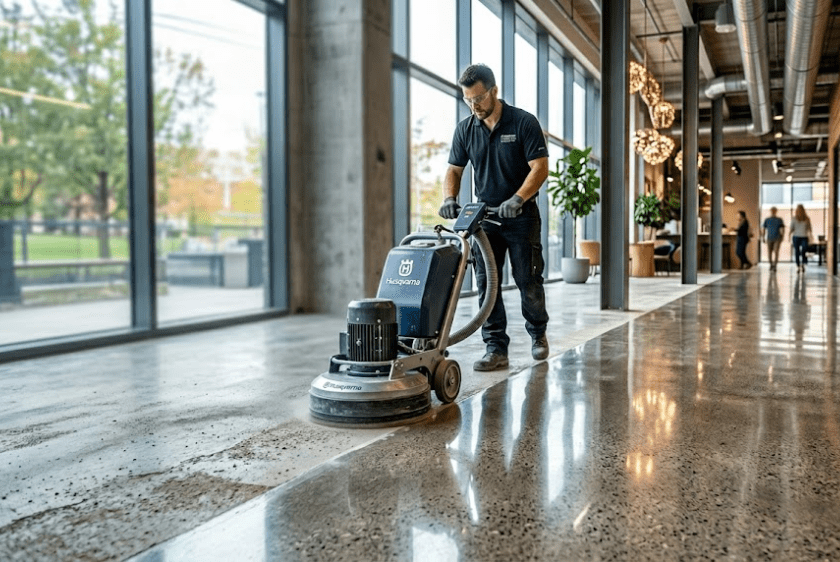
The most impactful upgrade you can make to any concrete surface starts with grinding and polishing. Concrete floor polishing services use progressively finer diamond-abrasive tooling to open up the surface, remove imperfections, and develop a natural sheen — without paint or coatings hiding what’s underneath.
There are different degrees of polish, usually measured in gloss units:
- Cream polish — Matte, low-gloss finish popular in industrial and rural environments
- Salt-and-pepper finish — Reveals fine aggregate for a speckled, natural look
- Full-aggregate exposure — A high-contrast look where larger stones become part of the design
- High-gloss polish — Mirror-like reflection that looks beautiful in commercial or residential areas
What makes this technique so realistic is the persistence. Well-polished flooring does not chip, chip, or fade like painted or coated surfaces can. It just wants repeated maintenance — and actually makes it less complicated to clean over time because of the density of the floor.
2. Concrete Staining: Bringing Color Without Losing Character
One of the most misunderstood tools in concrete finishing is color. A lot of property owners assume stained concrete looks fake or painted-on. In reality, concrete staining services work with the existing surface — penetrating into the slab rather than sitting on top of it.
There are main types:
The acid stain reacts chemically with the minerals in the concrete and gives brown, amber and terracotta earthy tones. No acidic floor looks exactly the same, as the answer depends on the specific metal composition of your slab. That variation is part of the fascination.
Water-based staining gives you more color control — rich blues, greens, grays, even blacks. These do not react chemically; Instead, they enter the hole and attach themselves to the floor. The end result is more uniform and yet far extra subtle than the painting.
Both approximate good form on clean, nicely prepared surfaces. If you go out of prep, the stain may not bond properly.
3. Sealing: The Step Most People Skip (and Shouldn’t)
Here in some many DIY and price class jobs are dismantled. Very little of an amazing polish or stain method without proper protection. A concrete floor sealer locks in the finish, prevents moisture from entering, resists oil and chemical stains, and extends the life of whatever you have added to the surface.
There are several types to distinguish:
- Penetrating sealers (silane, siloxane, silicate) bond without changing the appearance beneath the surface — perfect for driveways, patios, and outdoor boards
- Topical sealers (epoxy, urethane, acrylic) sit on top and provide a visible gloss or sheen — unusual for garage floors or commercial spaces
- Densifiers are often purchased before a topical sealer to harden the base from the inside out
The reapplication schedule is through site visitors and product, but a satisfactory seal made by skilled arms can remain for several years before contact is needed.
4. Decorative Overlays and Micro-Topping
If your current slab is cracked, stained, or chipped, count on not having to rip it out and start over. Decorative overlays follow a thin layer of cement-based fabric completely over the dominant surface, creating a fresh fabric for sharpening, staining, or texturing .
Micro-topping, in particular, has grown into a popular desire in modern interior design – you take a very lightweight, almost seamless look at just a few millimeters thick it is especially appealing on countertops, commercial floors and functional partitions.
5. Epoxy and Metallic Systems: High-Impact, Heavy-Duty
For spaces that need serious performance and visual appeal — think auto shops, breweries, commercial kitchens — epoxy systems deliver. But the metallic epoxy systems have taken this a step further aesthetically.
Metallic pigments swirl through an epoxy basecoat, creating three-dimensional, liquid-looking styles that shift with light. Not the same bottom shape. This bold flow, even when done well by experienced users, practically stops humans in their tracks.
Working with the Right Team Makes All the Difference
No amount of study can replace the expertise of men who have accomplished this many times. It depends on the material, but also on the practices of the flooring, the environmental conditions of an application, and knowing when to push away to preserve the underside of the surface.
Superior Floor Coatings, LLC has built its popularity on just this — finishes that are preserved within the real world, even though they look like a design magazine. Whether you’re a residential garage, industrial commercial space, or industrial warehouse, the process is the same: get the prep right, use the right products, and don’t cut corners on the finish.
The team at Superior Floor Coatings, LLC offers professional concrete floor polishing services tailored to each surface’s condition and the client’s goals. That means honest recommendations, not upsells.
Practical Tips Before You Start Any Concrete Finishing Project
- Test your slab for moisture. High moisture vapor transmission can cause adhesion failures in coatings and sealers. A simple test before you start saves you a costly redo.
- Check for existing coatings. Paint, old sealers, or glue residue need to be removed before any new finish will bond properly.
- Manage expectations on aggregate exposure. The look of a polished floor depends heavily on what’s in your specific slab. It’s not fully predictable until grinding begins.
- Plan for curing time. Most systems need 24–72 hours before foot traffic and longer before heavy use. Factor this into your project timeline.
FAQs: Concrete Floor Finishing
Q: How long does a polished concrete floor last? With proper care and regular maintenance, polished concrete can last for many years. It’s one of the most durable flooring options — and it doesn’t require waxing or stripping like VCT tile.
Q: Can staining be done on old, worn concrete? Yes, in many cases. The key is thorough surface preparation. Old adhesive, paint, or deep stains may affect how evenly a new stain absorbs, so be upfront with your contractor about the floor’s history.
Q: Is a concrete floor sealer necessary after polishing? For interior polished floors, a densifier is typically worked into the process itself. An additional topical sealer depends on the traffic and use case. Your contractor can advise based on your specific environment.
Q: How much does professional concrete finishing typically cost? It varies significantly by technique, floor condition, and square footage. Polishing generally runs $3–$12 per square foot; epoxy coatings are similar. Get a few quotes and ask what’s included in surface prep — that’s where quality differences really show up.
Q: Can I do concrete finishing myself? Some basic sealing can be DIY-friendly. But polishing, staining, and epoxy application require equipment and technique that typically aren’t worth attempting without experience. A poor application is often harder (and more expensive) to fix than starting clean with a professional.
Ready to Transform Your Floor?
Whether you’re starting from scratch or trying to revive a worn-out surface, concrete finishes are one of the highest-ROI upgrades you can make to any space and the results speak for themselves — and that they’re leftovers.
Superior Floor Coatings, LLC offers a free consultation to walk you through your options, inspect your slab, and suggest a finish that suits your finances and dreams. Don’t accept drab, bare concrete when a few professional palms can turn it into something really worth talking to me.
Contact Superior Floor Coatings, LLC during these days to schedule your consultation and see what is possible for your floor.


